



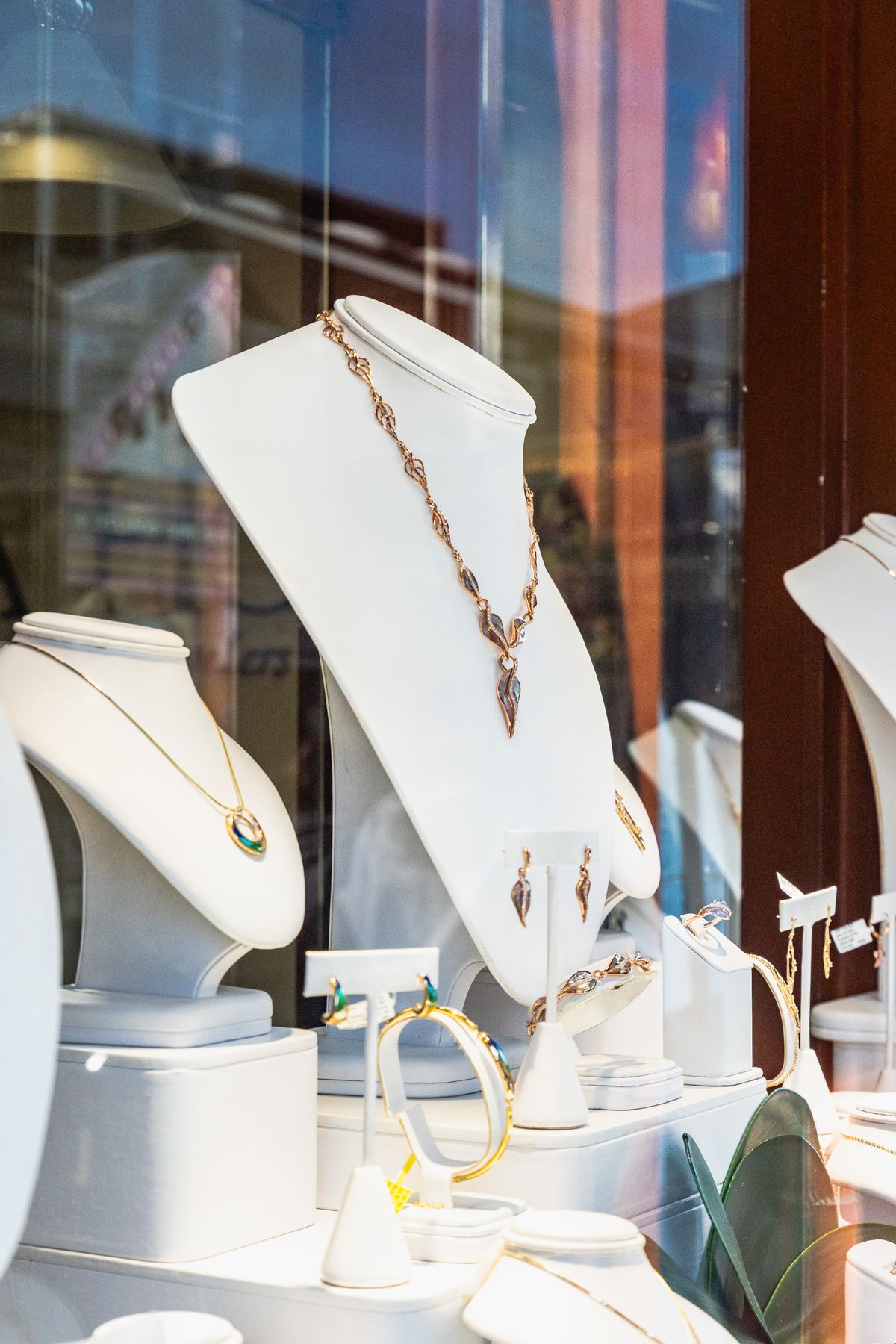
September is the month a jeweller’s window resets. Summer ends, footfall returns, the autumn fair circuit begins and, above all, the long climb towards December starts. Whatever you build now will be working for you for four months.
And there is a curious asymmetry here: most jewellers invest heavily in the piece and almost nothing in what holds it up. An excellent ring on a tired display reads as a mid-range ring. The support is invisible, but it registers.
Fewer pieces, better seen
The most common autumn mistake is filling the space. The campaign is coming, there is an urge to show everything, and the window ends up looking like a market stall. The opposite of the intended effect happens: the more pieces there are, the less each one is worth.
The rule of thumb is to choose one hero piece per visual zone and surround it with two or three supporting pieces, leaving air around them. That air is what the customer’s eye reads as a price bracket. When in doubt, remove something.
Height, angle and hierarchy
A flat window is not looked at, it is walked past. You need relief, and that comes from displays at different heights, not from placing everything on the same base.
- Eye level (between 1.40 and 1.60 m) is the premium zone. That is where what you most want to sell goes, not the cheapest item.
- Angled displays present rings and earrings at the angle they are actually seen from; laid flat, the customer only sees the edge.
- Busts and neck forms are essential for necklaces: a necklace lying flat loses its drape, which is precisely its selling point. The full range is in displays by jewellery type.
- Depth matters as much as height: stepping three levels back creates volume without adding pieces.
Lighting does half the work
It is the cheapest thing to improve and the one that gives the most in return. Two practical criteria:
- Colour temperature. Warm light (around 3,000 K) flatters gold and warm stones; more neutral light (around 4,000 K) flatters silver, steel and diamonds. If you carry both, separate the zones rather than settling on a middle point that flatters neither.
- Direction. Frontal light flattens. Spots angled across the piece produce the sparkle that makes a stone look alive. And keep light off the glass itself: reflections erase the whole window from the pavement.
Check your window from outside, standing on the street, at the busiest hour of the day. It is the only test that counts.
The background: colour and material
The background should disappear. Displays covered in suedette or velvet in neutral tones (cream, stone grey, black) absorb light and let the metal stand out; glossy backgrounds compete with the jewellery and dull it.
One seasonal note: earth tones and burgundy work very well in autumn as a single accent, provided the base stays neutral. The accent can then be swapped at Christmas without rebuilding the whole window.
Make the display and the box speak the same language
This is the detail that separates a considered shop from a merely tidy one. If the window is charcoal grey and the box you hand over is cream, the customer perceives a seam. They could not explain it, but they notice.
Ideally the display, the box, the bag and the gift carton share a colour family and a texture. It is easier than it sounds if you choose packaging by collection rather than piece by piece.
If you are exhibiting at autumn fairs
The autumn circuit (Vicenzaoro, Bijorhca, MadridJoya and the regional shows) has a rule many exhibitors forget: at a fair, the visitor walks past hundreds of near-identical cabinets. What holds the gaze is not more product but one clear idea.
- Take fewer references than you think you need and present them better.
- Use your own displays, not the ones the organiser lends: they are the same on every stand.
- Keep samples of your packaging on the stand. A trade buyer is working out how they will resell your piece, and the box is part of that calculation.
- Build a reduced version of your shop window: consistency between the fair and the point of sale.
And from here, the run-up to Christmas
The September window is the rehearsal for the December one. What you build now tells you what works and what does not, with time to correct it and, above all, time to order whatever is missing.
This is exactly the moment to close the campaign order: we set it out step by step in the Christmas countdown for jewellers, and if you are also weighing up a change of supplier, in our guide to choosing a packaging supplier.
Want to see the materials before deciding? Ask us for samples and a quote: we send single units so you can place them in your own window, under your own lighting and with your own pieces, before committing to anything.