



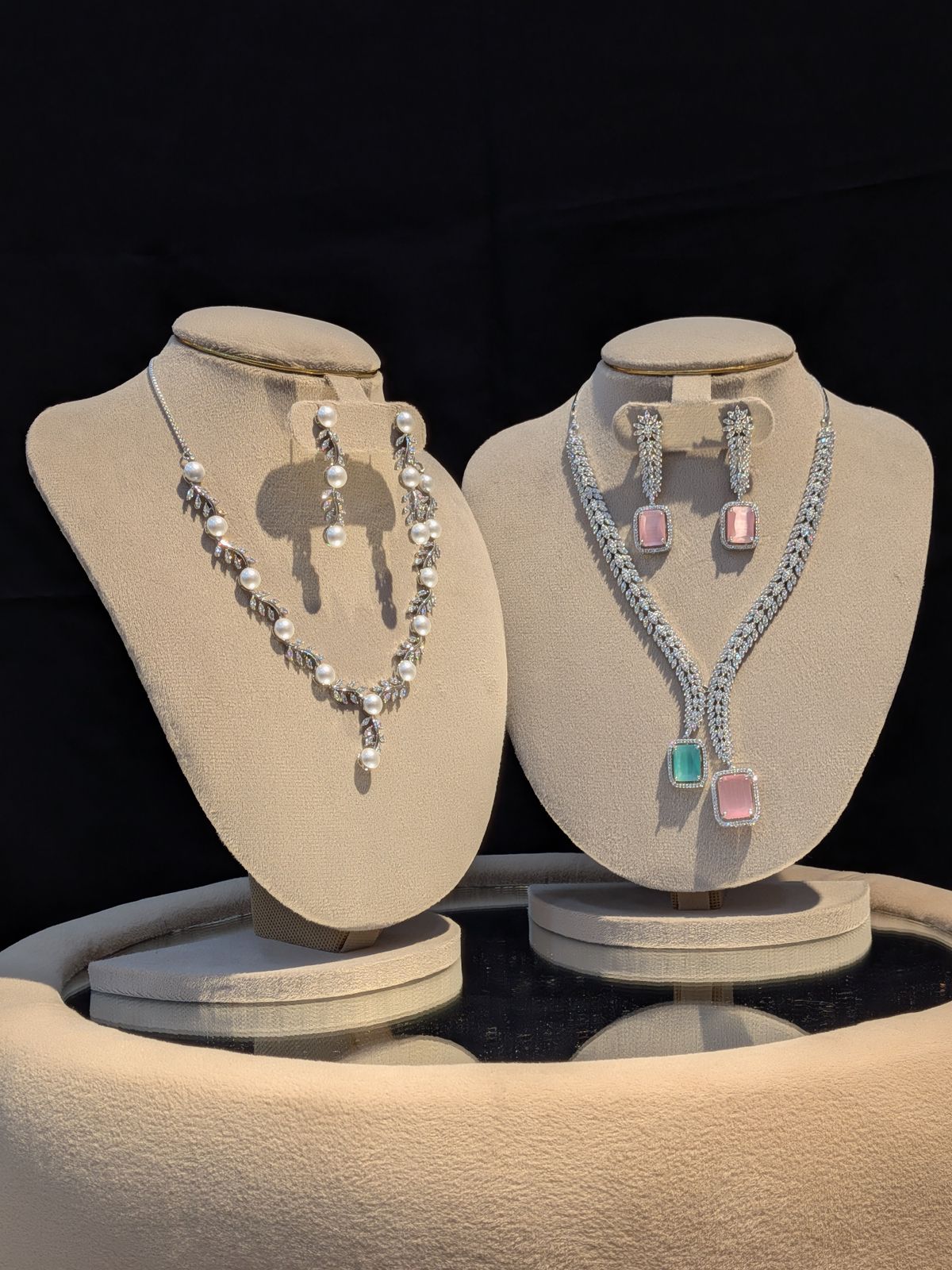
A necklace laid flat on a tray loses most of its appeal: the chain bunches up, the pendant twists and the customer cannot picture how it will look when worn. That is why busts remain the centrepiece of any jeweller’s or costume jewellery shop selling necklaces, chokers and pendants.
Choosing the right necklace display bust is not about buying several of the same model: height, neck width, material and colour all change how a piece reads. Here is what to check before ordering necklace busts and bibs for your window, your counter or your online shop photography.
Why a necklace needs volume to sell
A necklace is the hardest piece of jewellery to judge lying flat. A bust shows what a tray hides: the drop of the chain, where the piece sits on the neck and its true length, which is what raises most doubts at the counter. Once that is clear, the customer stops asking “how will it look on me?” and starts asking “do you have it in gold?”.
A bust also creates a high point that draws the eye. And if you sell online, photographing pieces on the same bust you use in store gives your whole catalogue a consistent look.
Bust height and size by necklace length
The most common mistake is using one bust size for everything. As a rough guide:
- Choker (around 35-40 cm): a short bust with a slim neck, so the piece sits snugly instead of floating.
- Princess (around 45 cm): a mid-height bust, with the pendant at collarbone level. It is the most versatile length, so it is worth having several.
- Matinee and opera (50 to 90 cm): a tall bust with a long chest, so the chain falls straight without touching the base.
- Long pendants and sautoirs: a tall bib or an extended torso; if the chain touches the base, the piece looks shorter.
In a cabinet, stagger the heights: tall busts at the back, medium ones in the middle and short ones at the front, so that no piece hides another. On the counter, short and medium busts work better, as they do not block the line of sight between you and the customer. For your seasonal window, see also our guide to building an autumn jewellery window that sells.
Material and colour: velour, linen or faux leather
Velour absorbs light and makes metal shine by contrast, which makes it the classic choice for fine jewellery, gold and gemstones; if your counter already uses velour display stands, keep the busts in the same finish. Linen brings a natural, matt texture that suits silver, designer jewellery and handcrafted collections, and it pairs well with linen display stands. Faux leather resists rubbing and wipes clean easily, which makes it ideal for busy counters.
For colour, contrast is the rule: yellow and rose gold stand out against black, navy or warm neutrals; silver and white gold against black or grey; coloured stones against neutrals that do not compete with them. And stick to one palette that matches your boxes: if the bust is black and the case the customer takes home is beige, the experience breaks down at the very last step.
Stock busts or bespoke displays
If you work with standard lengths and standard shop furniture, stock busts cover most needs and are easy to reorder.
Bespoke displays for necklaces and pendants make sense in three situations: your own collection with unusual lengths or volumes, a cabinet whose height or depth does not suit standard models, or a display that should be part of your brand identity, with a colour or finish of its own. Before asking for a quote, measure the usable space, note the maximum length of your pieces and settle on the colour.
Common mistakes and upkeep
- Oversized busts for delicate pieces: a fine chain on a bulky bust looks even smaller.
- Mixing colours and materials: three different finishes in one cabinet look untidy.
- Overloading: several necklaces on one bust only work when they are sold as a set; otherwise, one piece per bust.
- Leaving the chain loose: fasten the clasp at the back and, if the bust allows it, secure it with a discreet pin at the nape so the pendant stays centred.
- Dust and wear: dark velour shows every speck of dust; go over it regularly with a soft brush or a lint roller, keep it out of direct sunlight, which fades the cloth, and rotate pieces so they do not always mark the same spot.
How to combine busts with trays and boxes
Surround the bust with low trays of matching earrings and rings: the customer sees the main piece and, around it, what goes with it, which encourages add-on sales.
Then comes the handover: if the cabinet is lined in black velour, the necklace should leave in a box of the same tone, with an interior that keeps the chain from tangling. Among our luxury necklace boxes you can choose the collection that best matches your displays; the minimum order ranges from 12 to 100 units depending on the collection and is shown on each product page, and you can order a single-unit sample of the exact model before placing a larger order.
If you are torn between two heights or need a display adapted to your cabinet, get in touch through our contact page with the measurements of the space and the length of your pieces, and we will point you in the right direction.